Fall 2026, CairoShort Course
Seeing the Unseen
The Universal Role of Visual Attention in Our Everyday Lives
Course details
- Cycle
- Fall 2026, Cairo
- Starts
- Saturday, Nov 21
- Meets
- Saturday, 17:30–20:30
- Length
- 8 weeks
- Format
- Online
Share
Discuss it with AI
- Choose your preferred AI assistant.
- A new tab will open with a prompt prepared for this page.
- Press Send to begin exploring the page through dialogue, CILAS-style.
About the course
Every second, the human eye absorbs millions of data points, yet our conscious mind inherits only a crafted fraction. What invisible frameworks dictate what we see—and what we are systematically conditioned to ignore?
Welcome to The Universal Role of Visual Attention, an interdisciplinary inquiry into the ultimate currency of human perception, culture, and ethics.
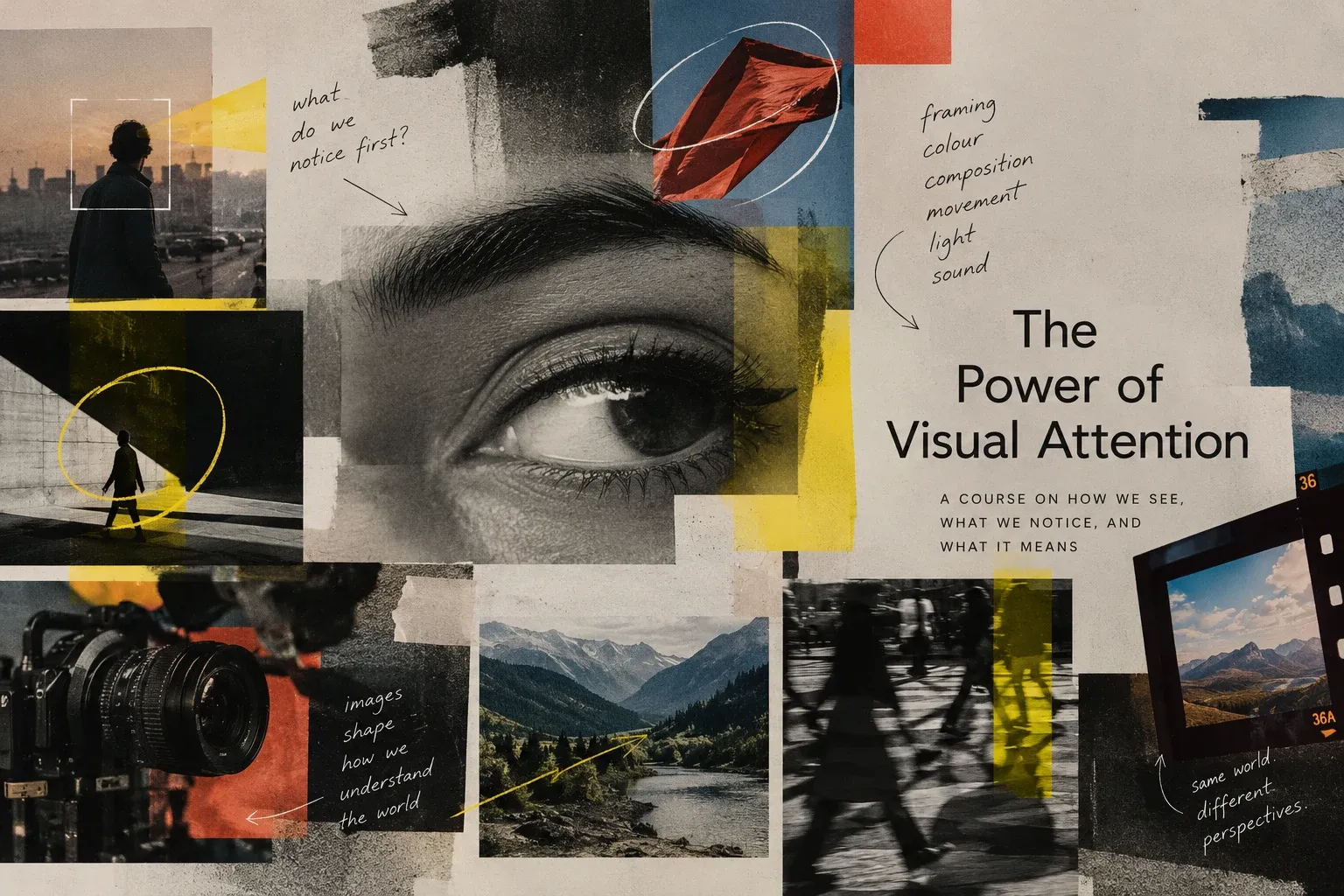
Visual attention is far more than a simple biological reflex; it is a foundational pillar of human agency, social structure, and creative expression. Bridging neuroscience, philosophy, fine art, and civic ethics, this course investigates how visual focus governs human behavior and decision-making. You will decode the evolutionary mechanics of gaze, evaluate how spatial architecture, medical practice, and legal frameworks direct human focus, and interrogate the aesthetic strategies filmmakers and artists deploy to construct narrative meaning. Crucially, we confront our digital age—critiquing how media ecosystems, AI, and emerging technologies capture, monetize, and fragment human consciousness.
Designed for thinkers, artists, scholars, and future cultural leaders across the liberal arts, this course challenges you to transcend passive observation. You will cultivate the critical vocabulary needed to dissect the visual forces structuring modern society—and reclaim control over your own cognitive landscape.
Who teaches it
Iffat R. is a Delhi-based visual artist, filmmaker, and multimedia producer exploring the role of visuals in shaping how we perceive, understand, and experience the world.
Her practice moves beyond the conventional boundaries of art and design, approaching visual language as something that influences every aspect of everyday life—from the way we communicate and consume information to how we interpret people, places, and ideas.
Through filmmaking, visual communication, and research-led storytelling, she is interested in discovering how images operate in ordinary contexts and how they shape our understanding, often without us realising it.
Her experience spans documentary storytelling, editorial projects, brand communication, motion graphics, and visual design. Her work spreads from conducting workshops about ethics of visual research at the University of Delhi to developing visual identities to some of the important projects.
As a visual artist, she continues to explore the relationship between seeing and understanding, bringing critical inquiry into everyday visual experiences.
Course flow
The flow may change as the course goes.
November 2026
How human visual attention evolved for survival; the neuroscience of top-down vs. bottom-up focus and distraction.
- Posner, M. I., & Petersen, S. E. The Attention System of the Human Brain.
- TED Talk: How the Brain Pays Attention (Mehdi Ordikhani-Seyedlar).
In class
- ExerciseExercise: Baseline eye-tracking demonstration / Visual Search Experiment (Treisman Feature Integration exercise).
Eye-tracking methodologies; the psychology of gaze, eye contact, and human connection in interpersonal discourse.
- Holmqvist et al. Eye Tracking: A Comprehensive Guide to Methods and Measures (Selected Ch. 1–2).
- Case Study: Analyzing gaze plots and heatmaps in face-to-face interaction vs. video calls.
In class
- ExerciseExercise: Heatmap analysis: Compare visual fixation duration on human faces vs. surrounding contextual cues.
December 2026
How attention operates in high-stakes environments—radiology/surgical diagnostics, architectural wayfinding/spatial anxiety, and eyewitness visual security.
- Gegenfurtner et al. Expertise Differences in the Comprehension of Visualization Materials in Radiology.
- Case Study: Architectural spatial mapping: Comparing wayfinding in hospital layouts vs. airport terminals.
In class
- ExerciseExercise: Diagnostic/Forensic simulation: Identify visual distractors in a simulated medical imaging or crime scene visual deck.
How classical and modern artists direct gaze through framing, color theory, balance, and visual rhythm.
- Arnheim, R. Art and Visual Perception: A Psychology of the Creative Eye (Chapter on Balance & Focus).
- Art Analysis: Comparative analysis of Velázquez’s Las Meninas and Manet’s A Bar at the Folies-Bergère.
In class
- ExerciseExercise: Composition breakdown: Deconstruct a classical painting by overlaying vector focal paths and visual weight lines.
How filmmakers and cinematographers steer the viewer's eyes using shot framing, camera movement, color grading, and cut transitions.
- Excerpts from Alfred Hitchcock’s Rear Window and Denis Villeneuve’s Dune.
- Cutting, J. E. Visual Attention and the Evolution of Film Editing.
In class
- ExerciseExercise: Shot-by-shot visual analysis: Map focal shifts across a 2-minute dialogue scene.
Attention steering in game UI/HUDs, spatial audio-visual cues, and the psychology of misdirection in sleight-of-hand magic.
- Kuhn, G. Experiencing the Impossible: The Science of Magic.
- Live breakdown of misdirection in stage magic (Apollo Robbins TED Talk / performance analysis).
In class
- ExerciseExercise: HUD redesign: De-clutter a complex video game interface to optimize player response times.
January 2027
AI-driven saliency modeling, gaze-tracking in VR/AR environments, dark patterns, and the ethics of attention monetization.
- Williams, J. Stand Out of Our Light: Freedom and Resistance in the Attention Economy.
In class
- ActivityTech Demo: Deep learning attention prediction tools (e.g., MIT Saliency Benchmark models).
- ExerciseExercise: Ethical audit: Evaluate a mainstream app interface for manipulative visual design patterns (e.g., infinite scrolls, flashing call-to-actions).
Presentation and critique of participant-led visual attention projects.
- Project Deliverable: Conduct an eye-tracking/visual analysis of a real-world scenario (e.g., short film, digital interface, architectural design, or diagnostic tool) or submit an original visual artwork applying strategic focus techniques.
In class
- ActivityClass Activity: Peer review panel and roundtable discussion on safeguarding cognitive focus in future technologies.
Get the CILAS newsletter
New courses, open calls and articles from CILAS, in your inbox.



18 October 2026
Join CILAS's Spring semester of 2026
- Spring 2026, Cairo