Fall 2026, CairoShort Course
Psychoanalysis Is an Antiphilosophy
Course details
- Cycle
- Fall 2026, Cairo
- Starts
- Sunday, Nov 22
- Meets
- Sunday, 17:30–20:30
- Length
- 6 weeks
- Format
- In person
- Taught in
- Facilitated in Arabic. Readings may be provided in Arabic or English, depending on available translations.
Share
Discuss it with AI
- Choose your preferred AI assistant.
- A new tab will open with a prompt prepared for this page.
- Press Send to begin exploring the page through dialogue, CILAS-style.
About the course
Someone says, “I know what I mean.” A slip, a symptom, an insistence—and that certainty begins to stammer. Psychoanalysis begins not by correcting the speaker, but by taking seriously the division in speech: the subject is not master of what it says, wants, or knows. Psychoanalysis Is an Antiphilosophy places this division at the centre of a six-week encounter with Freud and Lacan. What does psychoanalysis contest in philosophy’s promise that the subject can know itself and gather truth into a whole? Its answer is neither a rival system nor a refusal of thought. It is a singular praxis of listening: speech unfolds under transference, truth is only half- said, and the analyst’s act cannot be reduced to an explanation. We will test this claim where mastery falters: in the speaking slave, the fable’s equivocation, the sophist’s return, and the philosopher who reads Lacan without thereby practising analysis. These are not illustrations of a doctrine; each unsettles the question. Taught in Arabic, the course welcomes participants from any field; no prior study of psychoanalysis is required. We will read, argue, and listen together, leaving one question open: not what psychoanalysis knows, but what it does to the desire to know everything.
Learning objectives
By the end of the course, participants should be able to:
- Distinguish psychoanalysis, at an introductory level, from psychology, free-form interpretation, and a theory that reduces every difficulty to sexuality.
- Explain why a Freudian slip or symptom is not simply a fixed code waiting to be deciphered.
- Discuss Lacan’s treatment of ignorance as a passion connected to knowledge, while distinguishing his remarks from broader interpretations of philosophy as institutional ignorance.
- Read the four Lacanian discourses as arrangements of positions and relations, rather than as types of people; explain why the capitalist discourse is often presented as a mutation of the master’s discourse.
- Compare Hegel’s master–slave figure, Kojève’s influential reading, and Lacan’s use of the relation, without treating them as accounts of historical slavery.
- Interpret a fable’s possible effects—concealment, exposure, instruction, or the reproduction of authority—without treating the Aesopic corpus as direct testimony from an enslaved historical author.
- Formulate and defend an initial account of what psychoanalysis opposes when it calls itself an antiphilosophy.
Preparation
The required preparation is intentionally light: usually about 5–8 pages per week, with short primary passages supplied in a course packet. Some texts will be read together in class rather than assigned beforehand. Additional readings are marked Further exploration; they are optional follow-up for participants who have the time and appetite to pursue them. Arabic will be the language of facilitation. Readings may be provided in Arabic or English according to the available translation.
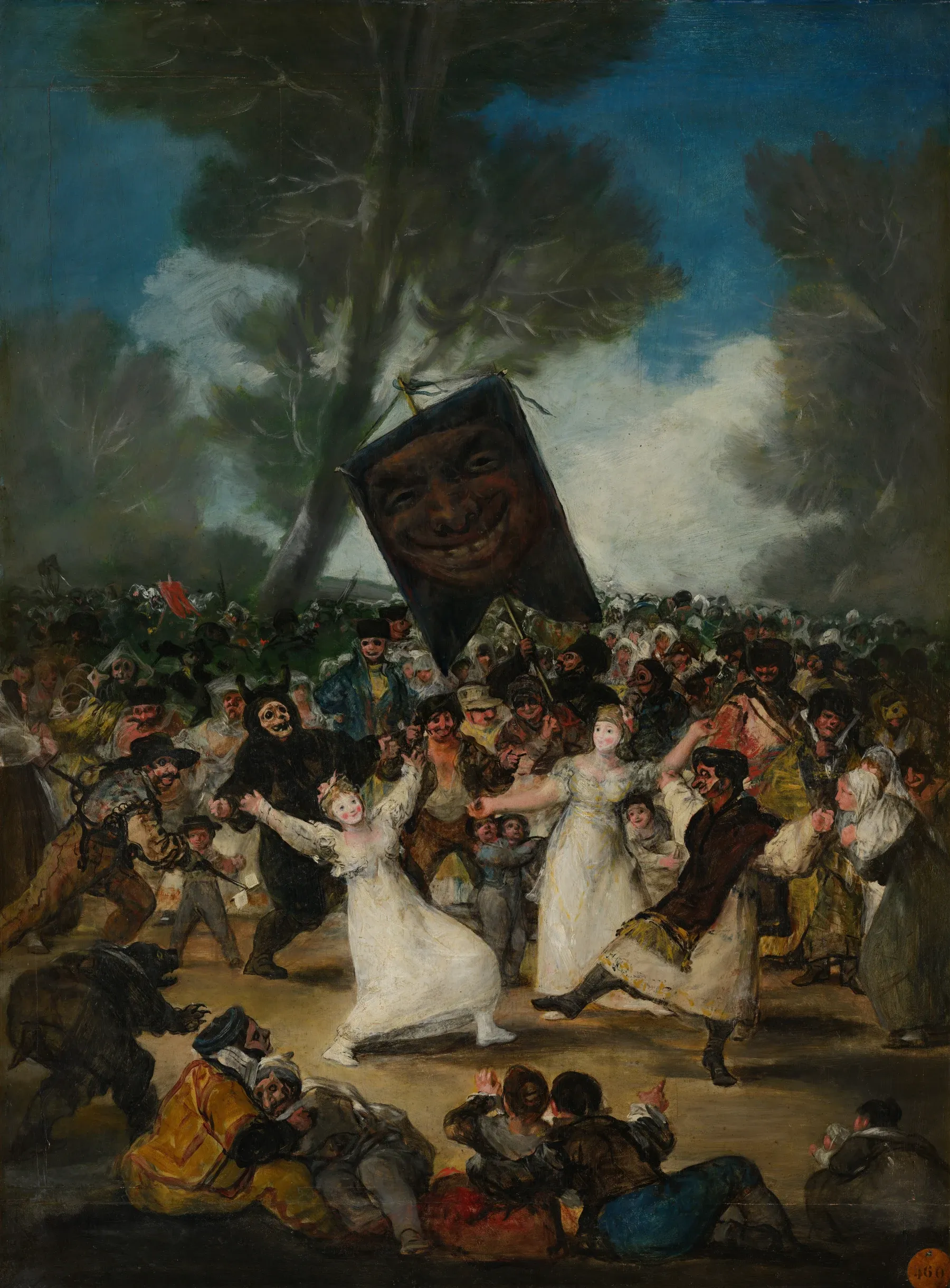
Artwork: Francisco de Goya, The Burial of the Sardine (El entierro de la sardina), c. 1812–1814. Oil on panel. Collection of the Real Academia de Bellas Artes de San Fernando, Madrid.
Who teaches it
Muhammad Al-Hinnawi is a writer and translator whose work is devoted to Freudian–Lacanian Psychoanalysis. His intellectual journey began with language and linguistics, followed by studies in political science at the Institute of Arab Research and Studies and mental health at Ain Shams University. He is currently engaged in the process of analytic formation within the Lacanian orientation.
He is the founder and director of Hamish, an independent space dedicated exclusively to Lacanian psychoanalysis in the Arabic-speaking world.
His published Arabic translations include Jacques Lacan and American Sociology: Beware of the Image by Duane Rousselle and Psychoanalysis Is an Antiphilosophy by Justin Clemens, both published by Al-Rawafed Al-Thaqafia Publishers (Beirut), as well as Disavowal by Alenka Zupančič, published by Hamish (Cairo). He is also the author of The Market of Promises: “Capitalism and Desire” and the Contemporary Arab Condition, published in the second issue of Muraja'at by Madarat (Cairo).
Course flow
The flow may change as the course goes.
November 2026
The course opens with a familiar confusion: psychoanalysis is often treated as a branch of psychology, a method for decoding literature, a doctrine about sex, or a way to explain everything by hidden meanings. We will establish a more precise point of departure. Freud’s account of parapraxis asks us to attend to interruptions and repetitions in speech—but does not give us a universal code in which each slip has one ready-made meaning. Lacan’s return to Freud sharpens the question of how the subject appears in speech, without making the analyst an all-knowing decoder.
How we will work
Participants begin by placing common claims about psychoanalysis on a shared board: “a science of personality,” “a way of interpreting symbols,” “a theory of sexuality,” and so on. In pairs, they then look closely at Freud’s Signorelli example: What details does Freud connect? What remains uncertain? What would count as evidence for an interpretation? The point is not to diagnose anyone in the room or to turn the example into a recipe.
What participants should take away
A preliminary distinction between listening for the effects of the unconscious and assuming that every accidental detail has a fixed, recoverable meaning.
The question we carry forward
If psychoanalytic knowledge does not arrive as a complete explanation, what kind of knowledge is it—and what role does not-knowing play in producing it?
- Sigmund Freud, “A Difficulty in the Path of Psycho-Analysis,” Standard Edition, vol. XVII, pp. 137–144 (8 pages).
- In-class handout: Freud’s account of forgetting the name “Signorelli,” from The Psychopathology of Everyday Life, Chapter 1 (about 2–3 pages).
- Jacques Lacan, “The Freudian Thing,” a brief course-packet passage (about 3 pages), to be read with guidance rather than as a first encounter with Lacan’s full argument.Optional further exploration.
Lacan’s remarks on ignorance invite a careful distinction. Ignorance can mean a lack of information; docta ignorantia names a learned recognition of the limits of knowledge;
and an institution may also organize what can be asked, taught, or acknowledged. These are not interchangeable. We will begin with Lacan’s account of ignorance as a passion related to knowledge, then test—rather than assume—the broader claim that philosophy can function as a system that fails to know what it excludes.
How we will work
Small groups sort short statements into three provisional categories: “not knowing yet,” “knowing that knowledge has a limit,” and “not wanting or being permitted to know.” They must explain what in each statement supports their choice. A fishbowl discussion then asks whether an institution can produce knowledge while also setting limits on what counts as knowledge.
What participants should take away
A working vocabulary for distinguishing different senses of ignorance—and an understanding that the claim about philosophy’s “institutional ignorance” is an interpretive thesis to be tested, not a direct conclusion attributed to Lacan.
The question we carry forward
If knowledge is bound up with positions, limits, and exclusions, how might we map those relations rather than describe them as personal traits?
- Jacques Lacan, The Knowledge of the Psychoanalyst, session of 4 November 1971: course-packet excerpt on ignorance as a passion, knowledge, and Nicholas of Cusa (about 4–5 pages).
- Nicholas of Cusa, On Learned Ignorance, Book I, Chapters 1–2 (about 3 pages in the course packet).
- Justin Clemens, Psychoanalysis Is an Antiphilosophy, Introduction, pp. 3–6 (4 pages). This offers one contemporary framing of the relation between psychoanalysis, philosophy, science, and literature; it is a position to examine, not a substitute for Lacan’s text.Optional further exploration.
December 2026
Lacan’s four discourses provide a way to examine how knowledge, authority, the divided subject, and objet petit a are arranged in relation to one another. They are not personality types, and the diagrams do not classify people as “masters” or “hysterics.” We will learn to read the positions before applying the schema to anything else. The capitalist discourse will enter as a later, altered configuration related to the master’s discourse—not simply as a fifth equivalent member of the original set.
How we will work
The group first assembles the four mathemes using cards bearing S₁, S₂, $, and a. Once participants can identify the positions, we will follow one carefully chosen example—such as an exchange in a classroom or a piece of public advice—through two different discourse configurations. The final discussion asks what changes in the relations among authority, knowledge, and the subject. We will avoid trying to fit several unrelated examples into the same session.
What participants should take away
An introductory ability to read the discourse diagrams relationally, and to explain why the capitalist discourse calls for a separate discussion rather than being treated as an uncomplicated “fifth discourse.”
The question we carry forward
The master’s position appears to command, but it depends on knowledge produced elsewhere. What does this dependence look like in Hegel, in Kojève’s reading of Hegel, and in Lacan?
- Jacques Lacan, The Seminar of Jacques Lacan, Book XVII: The Other Side of Psychoanalysis, session “Production of the Four Discourses,” 26 November 1969: course-packet excerpt (about 6–8 pages).
- One-page handout of the four discourse mathemes and their positions: agent, other, truth, and production.
- Jacques Lacan, “On Psychoanalytic Discourse: The Discourse of the Capitalist,” Milan, 12 May 1972: short course-packet passage (about 2 pages).In-class material.
This session takes up the master–slave relation as a sequence of different arguments, not as one theory passed unchanged from Hegel to Lacan. Hegel examines recognition, dependence, and transformation; Kojève gives the relation a historically influential anthropological and political reading; Lacan uses it in his account of knowledge, discourse, and the subject. Those philosophical figures must be kept distinct from the historical reality of slavery.
How we will work
Text stations focus on four questions: Who seeks recognition? Who performs the work? Who possesses or produces knowledge? What does each account leave out? Groups then compare their answers, noting where the same vocabulary—“master,” “slave,” “dependence”—is doing different work.
What participants should take away
A clear distinction among Hegel’s philosophical figure, Kojève’s reading, Lacan’s use of the relation, and historical testimony about slavery.
The question we carry forward
A historical document identifies its speaker and context. A fable often does not. What kinds of speech become possible—or more difficult—when a story speaks indirectly?
- G. W. F. Hegel, Phenomenology of Spirit, §§178–184 and §§189–196: course- packet excerpt (about 7–9 pages, depending on translation).
- Alexandre Kojève, Introduction to the Reading of Hegel, “In Place of an Introduction”: excerpt on desire, recognition, and the struggle for prestige (about 4 pages in the course packet).
- Justin Clemens, Psychoanalysis Is an Antiphilosophy, Chapter 3, “Revolution or Subversion? Jacques Lacan on Slavery,” pp. 63–68 (6 pages).
- A brief historical document will be read as a counterpoint, not as an illustration of Hegel. One possible text is Frederick Douglass’s account of the attempt to prevent his learning to read, from Narrative of the Life of Frederick Douglass, Chapter VI (about 2–3 pages). The discussion will keep the historical specificity of racialized chattel slavery in view.In-class comparison.
The session studies the fable as a form of speech that can address power obliquely. It does not presume that the fables attributed to Aesop were composed by an enslaved author as deliberate resistance. The surviving Life of Aesop is a later fictional biography, and the fables belong to a complex tradition transmitted across sources. We will examine the literary figure of the slave-fabulist and ask what the fable does: conceal a criticism, expose a relation, offer instruction, or repeat the very wisdom it appears to challenge.
How we will work
Groups read one fable in three ways: as a moral lesson, as an indirect address to someone powerful, and as a story that may reproduce a hierarchy. They must point to specific words or turns in the narrative that support each reading. A second exercise asks one group to retell a story as direct advice and another as a fable; participants compare what changes in the speaker’s position and the listener’s freedom to respond.
What participants should take away
A way to discuss indirect speech without assuming that concealment automatically equals resistance—and a sense of how translation and framing can change whom a story appears to address.
The question we carry forward
If neither the fable nor a compelled confession gives us transparent access to what a subject knows, what position does the analyst occupy in relation to speech and knowledge?
- Justin Clemens, Psychoanalysis Is an Antiphilosophy, Chapter 5, “The Slave, The Fable,” pp. 102–108 (7 pages).
- “The Wolf and the Lamb” and “The Fox and the Crow,” in a short course packet (about 1–2 pages total).
- Ibn al-Muqaffaʿ, Kalila wa Dimna, brief passage from “The Lion and the Ox” (about 3–4 pages in the selected Arabic edition). This is a comparison across fable traditions, not an Aesopic equivalent.
- Justin Clemens, Chapter 6, “Torture, Psychoanalysis and Beyond,” pp. 123–124 (2 pages), for a carefully bounded discussion of coerced speech. This will be assigned as optional follow-up, not treated as evidence that fable and torture are the same kind of speech situation.Optional further exploration.
The final session gathers the course’s threads. We return to the ways psychoanalysis has unsettled philosophical mastery: the subject is not fully transparent to itself; knowledge is bound up with ignorance and desire; discourse positions its speakers; and a story or symptom cannot be reduced to a settled message. The question is what follows from this: is antiphilosophy simply a set of arguments against philosophy, or does psychoanalysis make its opposition felt in a distinct practice? Alain Badiou offers one of the most influential accounts of Lacan as an antiphilosopher. We will read his framing closely, then test its reach: what does it clarify, and what might it subordinate to a philosopher’s account of psychoanalysis? The term itself is not
Badiou’s coinage—Lacan uses “antiphilosophy” in “Peut-être à Vincennes”—but Badiou gives the designation a sustained theoretical shape. Lacan’s reference to the sophist opens a related question: what could it mean for the sophist to be present in our time? The course will treat this as a problem, not an identity. The analyst is not simply an ancient sophist in modern dress. We will ask what the comparison brings into view about speech, truth, and the analyst’s position—and what it leaves out. Finally, a short passage by Žižek lets us distinguish a philosopher’s reading of psychoanalysis from psychoanalysis as a praxis. The distinction is methodological: a philosophical interpretation of analytic concepts can be illuminating, but it is not itself the analytic act.
How we will work
Participants first make a map of the course’s recurring tensions, using brief passages from earlier sessions: slip and interpretation; knowledge and ignorance; the positions in a discourse; philosophical mastery and dependence; indirect speech and authority. Small groups then compare Lacan’s and Badiou’s accounts of antiphilosophy, asking what each makes visible and what it risks making too coherent. A final close-reading exercise puts the Žižek excerpt beside Lacan’s account of analytic praxis: What can philosophical interpretation of psychoanalysis do? What does the word praxis add to the question? We end with a roundtable in which each participant offers a provisional answer to the course’s central question: What does psychoanalysis oppose when it opposes philosophy—and what does it do, beyond making that opposition into an argument?
What participants should take away
Participants should leave able to distinguish several dimensions of psychoanalysis’s antiphilosophical position, explain what Badiou’s account contributes and where it can be questioned, and discuss Lacan’s sophist comparison without collapsing the analyst into a rhetorician. Most of all, they should be able to say why the course ends with psychoanalysis as a praxis: not simply a doctrine about knowledge, but a practice whose position and effects have to be examined.
- Alain Badiou, Lacan: Anti-Philosophy 3, Session 1, “November 9, 1994,” pp. 1–5 (5 pages). We will focus on how Badiou defines the task of identifying an antiphilosopher and positions Lacan within that account.
- Slavoj Žižek, “Lacan: At What Point Is He Hegelian?”: a three-page course-packet excerpt on Žižek’s philosophical engagement with Lacan.
- Jacques Lacan, The Seminar of Jacques Lacan, Book XI: The Four Fundamental Concepts of Psychoanalysis, Chapter I, “The Freudian Unconscious and Ours,” pp. 6–7 (2 pages), on praxis.
- Jacques Lacan, “Peut-être à Vincennes,” in Autres écrits, pp. 314–315 (2 pages), on antiphilosophy and the “educational” supposition of university discourse.Read and discussed in class.
- Jacques Lacan, The Seminar of Jacques Lacan, Book XII: Crucial Problems for Psychoanalysis, session of 12 May 1965: a brief course-packet passage on the sophist and the analyst (about 2–3 pages).Read and discussed in class.
Get the CILAS newsletter
New courses, open calls and articles from CILAS, in your inbox.



18 October 2026
Join CILAS's Spring semester of 2026
- Spring 2026, Cairo