Spring 2015, CairoThematic Course
Walk like an Egyptian Philosopher
Examining justifications for tolerance
Course details
- Cycle
- Spring 2015, Cairo
- Starts
- Thursday, Mar 26
- Meets
- Thursday, 10:00–12:30Thursday, 17:00–19:30
- Taught in
- English
Share
Discuss it with AI
- Choose your preferred AI assistant.
- A new tab will open with a prompt prepared for this page.
- Press Send to begin exploring the page through dialogue, CILAS-style.
About the course
Interaction among people with differing ideas, beliefs, and practices is an everyday reality in our increasingly globalised, urbanised, and digitised world. Many agree that tolerance and toleration, on both an individual and socio-political level, are necessary for healthy navigation of our complex landscapes. Toleration, however, is an elusive and paradoxical value; it is not always clear why and to what extent we should tolerate ideas and beliefs that, by definition, we think are wrong.
In this course, we will explore the nature and limits toleration and the contexts in which it is expressed, practiced, tested, and transformed. We will look at various justifications for toleration through the work of thinkers including John Locke, John Stuart Mill, Baruch Spinoza, Bernard Williams, Charles Taylor, John Rawls, Susan Mendus, Jeremy Waldron, David Heyd, and Carlos Frankel.
Throughout the course we will examine current and historical examples of toleration and evaluate the extent to which theory and practice can and do inform one another. We will ask questions such as, how is toleration taught in formal education settings? What do immigration policies say about institutionalized practices of toleration? What types of speech should be tolerated and to what degree can the boundaries be tested?
Students will develop argumentative ability through classroom debate. As a final project, students will be asked to present a framework for grounding toleration in principled practice based on their own experience and context.
expectations
Participants are expected to attend no less than 80% of classes with a readiness to engage in philosophical debate.
Participants are further expected to engage with assigned reading, viewings and write short, weekly response papers.
Participants are expected to present a framework both orally and in writing for grounding toleration in principled practice based on their experience and context.
why apply?
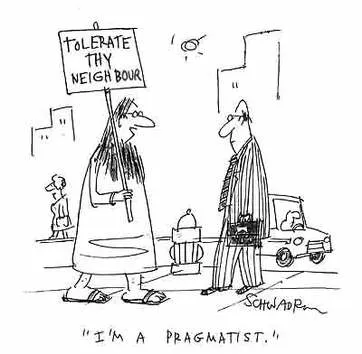
To familiarise yourself with pragmatic, moral, and meta-ethical arguments for toleration.
To analyse the relationship between toleration and pluralism, multiculturalism, relativism, social norms, equality, religion, education, and autonomy.
To examine tolerance as an attitude, character trait, or personal virtue vs. toleration as a socio-political value or institutional arrangement.
To discuss various forms that toleration can take such as resignation, indifference, social acceptance, curiosity, and enthusiasm for people different than ourselves.
To discuss toleration in relation to race, class, and gender.
To develop the ability to argue both sensibly and sensitively.
To identify theories of toleration at play in current events.
Who teaches it
Anne MISHKIND is passionate about education as a holistic transformative process, and as a means to increase opportunity, economic mobility, and meaningful participation in the political process. As an undergraduate at NYU's Gallatin School she concentrated in philosophy; a graduate student at the University of Cambridge she studied political thought and intellectual history. Anne is interested in the role of education in shaping shared social and cultural values, political identity, and a common sense of political purpose. Her past experience includes education policy analysis, working with at-risk middle and high school students, and teaching basic education courses for adults. In addition to her role as visiting fellow at CILAS, she works as an education policy analyst at the American Institutes for Research, focusing on issues of equity and access for low-income, minority, and first-generation college students in the US.

Get the CILAS newsletter
New courses, open calls and articles from CILAS, in your inbox.



18 October 2026
Join CILAS's Spring semester of 2026
- Spring 2026, Cairo