Spring 2017, CairoThematic Course
To Stand With the Dreamers: On Utopia
Course details
- Cycle
- Spring 2017, Cairo
- Taught in
- English / Arabic
Share
Discuss it with AI
- Choose your preferred AI assistant.
- A new tab will open with a prompt prepared for this page.
- Press Send to begin exploring the page through dialogue, CILAS-style.
"The here and now is a prison house. We must strive, in the face of the here and now’s totalizing rendering of reality, to think and feel a then and there. Some will say that all we have are the pleasures of this moment, but we must never settle for the minimal transport; we must dream and enact new and better pleasures, other ways of being in the world, and ultimately new worlds." Jose Munoz “The most tragic form of loss isn't the loss of security; it's the loss of the capacity to imagine that things could be different.” Ernst Bloch
About the course
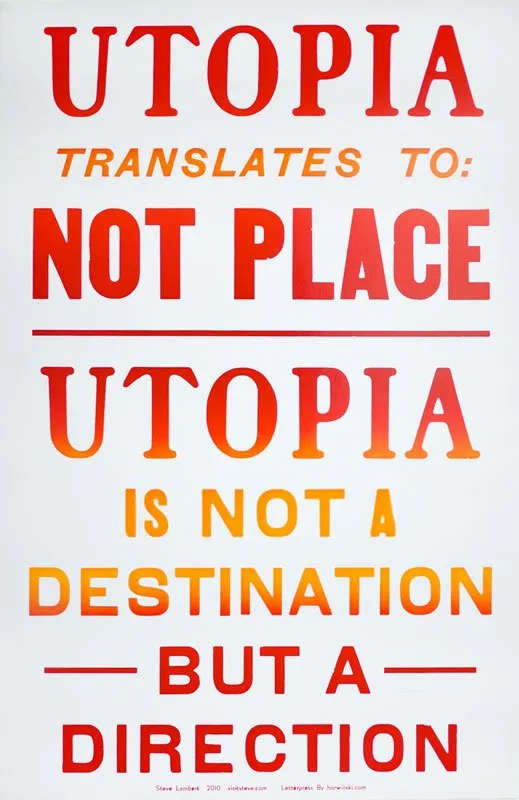
This course offers an overview to Utopia and Utopianism. The word Utopia was coined by Thomas Moore in his 1516 novel “Utopia”, to describe a “perfect” ideal city that the novel takes place, and etymologically It means the good place that is no place or the good place that doesn’t exist. This word went to become a literature genre, reflecting good places (utopias) and bad places (dystopia). Utopianism on the other hand can be defined as social dreaming, or the dreams and imaginations of a society or the concept/idea of utopia and its pursuit for the good place.
We start by defining utopia through literature and theory from the field of Utopian studies. This course also means to investigate the relationship between imagination and fiction from one side and the sociopolitical from the other. The course starts from conceiving Utopia as the education of desire and Utopia as hope and it speaks to the “utopian impulse” in humans for a better life. Utopia as a vision of the “good life” starts from refusing the present and locating the potentialities and possibilities of better life. Also this course moves beyond theory to look at the everyday life utopianism and how utopia can be used as a vehicle for radical transformation. Because of the special nature of utopia, this course is an interdisciplinary between the arts and the social sciences. It’s meant to be a collective exploration and the reflections of the participants are important to the outcome of the course .We will be reading the work of Ernst Bloch, Ruth Levitas and Lyman Tower Sargent among others.
The course objective is to offer an introduction to the concept of utopia and how can we use it to critically think about the social, political and the personal. It gives an overview of the field of utopian studies, different themes within it and the current trends. To challenge the common misconceptions about utopia. To question utopia and its relevance to today’s realities. It will also explore these topics in a way that makes justice to the imaginative, radical, poetic and artistic nature of Utopia.
Who teaches it

Get the CILAS newsletter
New courses, open calls and articles from CILAS, in your inbox.



18 October 2026
Join CILAS's Spring semester of 2026
- Spring 2026, Cairo