Spring 2022, CairoThematic Course
The Threshold of Fire: Incendiarism, Hysteria, and Civilization
Course details
- Cycle
- Spring 2022, Cairo
- Length
- 6 weeks
- Format
- Online
- Taught in
- English
Share
Discuss it with AI
- Choose your preferred AI assistant.
- A new tab will open with a prompt prepared for this page.
- Press Send to begin exploring the page through dialogue, CILAS-style.
About the course
Fire is imagined as the first invention of “man.” It inaugurates humanity into technology, it fuels civilization, and arms its march and its ability to defend itself.
It is also imagined as a destructive force, something that flows out of control, defies logic and subverts order, a licentious form that is reminiscent of, according to the predominant modernistprejudices, primitive populations, children, and women.
This course is about how, in the hegemonic western thought, there exists a hierarchy between two kinds of fire: the first rational, regimented (in firearms and steam engines), and productive; the fire of the modern state, of western superpowers, and of the white man, mirroring the dominant understandings of civilization and masculinity. The other irrational, licentious, hysterical, and destructive, mirroring the dominant imagination of primtivity and hysteria, the fire of non-Europeans, of women, and of revolutionary crowds.
Through the lens of fire, this course examines the hierarchical dichotomies that are central to western—and more broadly modern— thought: the state vs. revolution (or the crowd), the civilized vs. the savage, the proper vs. the licentious, the sane vs. the hysterical, and the masculine vs. the feminine.
To trouble this modernist/Western typology of fire, and of human forms, we will pay special attention to how fire is represented at the frontlines of the colonial encounter, at the frontlines between revolution and counterrevolution, and the frontlines between sexist discourses and women reclaiming their bodies and agencies. This archive will hopefully allow us to both deconstruct the hegemonic narrative and look at the ways whereby subaltern groups have internalized, appropriated, or wholeheartedly subverted this hegemony.
My aim is to counterpoise the course’s theory-heavy content with a hands on experience with archival material. This will turn some of our sessions into a virtual research workshop, and an experiment with deconstructing and reconstructing narrative.
Who teaches it
Ahmed Diaa Dardir holds a PhD from Columbia University in Middle Eastern Studies and the highly esteemed position of “Sadīq CILAS.” His research focuses on questions of colonialism, subjectivity, and power. As a CILAS fellow, Ahmed has conducted and coordinated various courses and workshops in the Humanities combining Political Theory, History and Literature, including two workshops on Shakespeare. Ahmed is also a huge fan of theatre and has some experience in the field.
From the fellow Course Format: The course will take place online. Part of the reason is to be able to share and examine documents, film clips, and other material in real time. In many of the sessions I will share primary and archival documents—including clippings from newspapers, excerpts from governmental documents, and photographs I took from various archives, and divide the students into groups in order to closely scrutinize these documents. We will then reconvene so that we can build up our understanding of history, and of the theory with which we understand history, from each group’s experience with its archive. Hopefully, this will help us connect critical theory to a critical practice. What follows is a tentative and preliminary course flow, which is open for modifications as the class discussion demands or allows.
Course flow
Sessions without a date
This week’s discussion explores a theme that will be central for our upcoming discussions: how fire is imagined in modern thought as a threshold between “man” and other subhuman forms. We will pay special attention to how this threshold operates in colonial literature, and the place of the human child and the indigenous subject in relation to this threshold.
Ahmed Dardir, “Threshold of Fire: Man the Shooter and his Incendiary Other.” (And reflect on the hubris of the instructors who assign their own writings…)
- The Jungle BookRudayrd Kippling
- Robinson CrusoeDaniel Defoe
- Man FridayAdrian Mitchell
- Man Fridayfilm, 1976
- The Jungle Bookfilm, 1967
- The Jungle Bookfilm, 2016
- Threshold of Fire: Man the Shooter and his Incendiary OtherAhmed Dardir
In class
- DiscussionThis week’s discussion explores a theme that will be central for our upcoming discussions: how fire is imagined in modern thought as a threshold between “man” and other subhuman forms.
Historically, counterrevolution has narrated the terrors of revolution through the tropes of incendiarism and arson. This week we will look at examples—from literature, journalism, and official governmental documents— where incendiary fire stood for revolutionary destruction and chaos. What understandings of fire, then, emerge from this discourse? And what understandings of the crowd, revolution, and chaos?
- A Tale of Two CitiesCharles Dickens (excerpts)
- الحريق عمدًاجريدة مصر، 1919/3/10
- Correspondences Respecting the Riots at Alexandria on the 11th June 1882UK Foreign Office, the National Archives, UK, FO 881/4741.
- محاكمة عرابيجريدة الجوائب، 1881/12/12
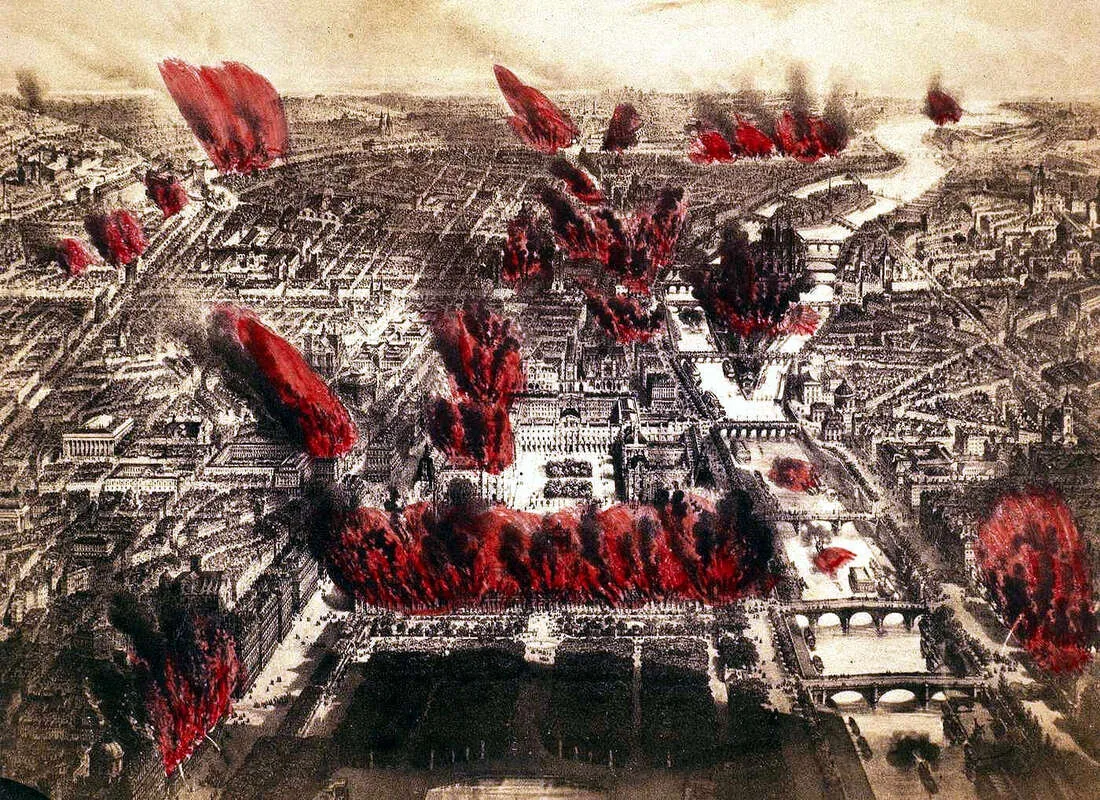
This week we will turn to how incendiary fire was, in counterrevolutionary discourse, especially in response to the Paris Commune (1871), was attached to the figure of the female revolutionary, to sexist tropes of female hysteria, and to the feminine body, opposed to the purposeful and manly fire of the state. These representations served to both discredit revolution and revolutionary fire by attaching it to hysterical femininity, and discredit femininity by attaching it to incendiary fire.
- Ventriloquized Bodies: Narratives of Hysteria in Nineteenth-Century FranceBeizer, Janet. (excerpts)
- La Petroleusepainting
- Les AliénistesSarcey, Francisque. Gaulois. 28 May 1871, 1.
- Les CommuneuxSarcey, Francisque. Gaulois. 6 June 1871, 1.
- Histoire de la Commune de 1871Lissagaray, Prosper-Olivier. (excerpts)
- Revolution in ParisThe Standard, 29/3/1871
- The Fete of the CommuneThe Standard, 31/03/1871
This week we will trace how the racialized and gendered understandings of fire intersect in counterterrorism discourse.
Through looking at cinematic representations, newspaper articles, governmental documents, and academic texts, we will investigate how
looks at how representations of the 1970s terrorism of the European “far left” is anchored in stereotypical and misogynist notions of hysteria, and latched to hysterical and licentious female bodies; we will also investigate how the figure of the “Muslim terrorist” is contaminated by the figure of the “hysteric” either through tropes of failed and perverse masculinity or through the persistence of the figure of the licentious female terrorist side by side with the racialized terrorist.
- The Baader Meinhof Complexfilm, 2008
- CarlosMiniseries, 2010
- Terrorist AssemblagesJasbir Puar (excerpts)
- The Element of MadnessKoenen, Gerd. Sign and Sight, 7 Dec. 2009
- ‘Bonnie und Kleid’: Female Terrorists and the Hysterical FeminineBielby, Clare. Forum, vol. 2, Spring 2006, pp. 1-18.
- Violent Women in Print: Representations in the West German Print Media of the 1960s and 1970sBielby, Clare. Camden House, 2012.
On the 26th of January 1952, many buildings in central Cairo caught fire. This session examines two different representations of this event: the colonial representation, and the indigenous anti-colonial response.
- Egypt in TransitionLacouture & Lacouture
- كيف دبر فاروق حريق القاهرةجريدة المصري، 1952/8/24
- قطعة من أوروبارضوى عاشور
This week is left open to allow for the examination of alternative understandings and imaginations of fire. Students are encouraged to look into alternative and/or counterhegemonic archives, whether this means revisiting the themes already explored in this course, or opening up new themes.
The discussion topics may include, but are not limited to: Fire in Greek mythology; Fire in the Magian/Zoroastrian faith.; Fire and Islam.; Fire in other modern archives.; Fire and Feminism/ the Petroleuse after the Paris Commune.
In class
- DiscussionThe discussion topics may include, but are not limited to: Fire in Greek mythology; Fire in the Magian/Zoroastrian faith.; Fire and Islam.; Fire in other modern archives.; Fire and Feminism/ the Petroleuse after the Paris Commune.
Get the CILAS newsletter
New courses, open calls and articles from CILAS, in your inbox.



18 October 2026
Join CILAS's Spring semester of 2026
- Spring 2026, Cairo