Spring 2021, CairoThematic Course
Critical Theory and Social Change - Part I
The Age of Great Revolutions
Course details
- Cycle
- Spring 2021, Cairo
- Starts
- Wednesday, May 19
- Meets
- Wednesday, 17:30–19:30
- Length
- 3 sessions
- Taught in
- English
Share
Discuss it with AI
- Choose your preferred AI assistant.
- A new tab will open with a prompt prepared for this page.
- Press Send to begin exploring the page through dialogue, CILAS-style.
About the course
What can moments of upheaval, revolution, and political and social change tell us about the theories they were attached to? What can theory tell us about social change? How does political and social theory respond to change? Is there an intellectual history for revolution and counterrevolution? This course aims to provide a survey of the great political, social, and intellectual revolutions that shaped the nineteenth and early twentieth century and set the tone for the years that followed. It aims to ground the major philosophical interventions of the century (notably Hegel and Marx) in revolutionary practice. It is in fact astonishing how theories that seem obscure and undecipherable become clear and lucid once read in the light of the history that shaped them.
This course thus treats theory and practice as intricately bound and sometimes inseparable. It approaches critical theory as the specific intellectual history of the material political and social changes they accompanied.
In addition, we will explore what it entails to take these theories out of their historical contexts and apply them to others: what then is modified, revised, and/or preserved? In short this course is an exercise of putting theory in context and out of context.
Through this dialogue between theory and practice, the course aims to provide an introduction to critical theory, an introduction to the history of revolutions, and an exercise in critical thinking.
Who teaches it
Ahmed Diaa Dardir holds a PhD from Columbia University in Middle Eastern Studies and the highly esteemed position of “Sadīq CILAS.” His research focuses on questions of colonialism, subjectivity, and power. As a CILAS fellow, Ahmed has conducted and coordinated various courses and workshops in the Humanities combining Political Theory, History and Literature, including two workshops on Shakespeare. Ahmed is also a huge fan of theatre and has some experience in the field.
From the fellow PS: Although part 2 of this course will be based on the discussions we have in part 1, parts 1 and 2 of this course could be taken separately; students who are interested in one are not required to enlist in the other). Students are also encouraged to participate in the parallel writing workshop, which aims to culminate in a final publication, and which will be co-hosted by the facilitator of this course.
Course flow
May 2021
Our aim in the first three sessions is to discuss the history of the French Revolution (including the Revolution as a theatre of events), the Haitian Revolution, the Napoleonic coup d’état, and how these events were in conversation with major intellectual interventions (not only Hegel’s Phenomenology of the Spirit but also Beethoven’s Eroica).
In class
- ExerciseIn our first session, we will be revisiting some of our pre-conceptions concerning the French Revolution through a series of in-class exercises. This discussion will set the course for the following sessions.
June 2021
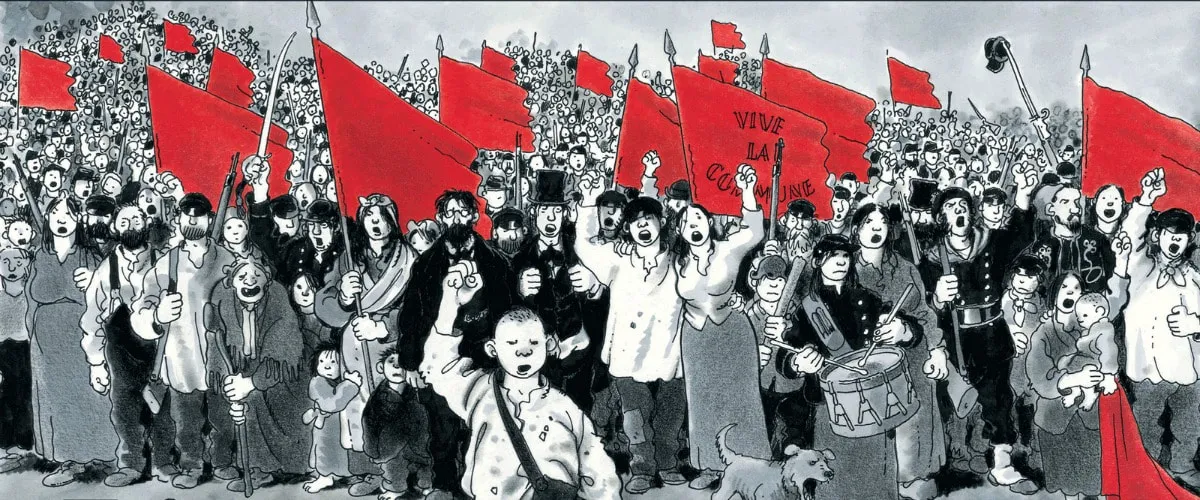
The French Revolutionary upheavals, especially the ones extending from 1848 to 1871, provided a laboratory for modern politics, revolutionary practice, counterinsurgency, and political theory. Our aim from this discussion is twofold: we aim to examine how theory engaged with revolutionary practice as exemplified by two of Karl Marx’s most incisive texts, The Eighteenth Brumaire of Louis Bonaparte and Civil War in France, which we will read in the light of the events that shaped them. We will also seek to examine how these events comprised a laboratory in counterrevolutionary practice, and how racism and sexism came to the aid of the state and became enshrined in state discourse and practice during these events.
- The Eighteenth Brumaire of Louis BonaparteKarl Marx.
- Civil War in FranceKarl Marx.
This episode will disrupt the privileging of the Western Europe, which the previous episodes may be guilty of, by shifting the lens to the Russian Revolution. We will primarily focus on writings by Vladimir Lenin, noting how the Russian revolution was inspired by earlier episodes of revolutionary history, how Lenin read Marx, and how the Russian Revolution and Lenin influenced revolutionary theory and practice worldwide. We will also pay special attention to how the question of imperialism was integrated with the question of class in the theory and practice of the Russian Revolution. This will set the stage for part two of this course, which will be titled “A Dying Colonialism.”
- Writings by Vladimir LeninFocus of the session, no specific work named in the flow.
Get the CILAS newsletter
New courses, open calls and articles from CILAS, in your inbox.



18 October 2026
Join CILAS's Spring semester of 2026
- Spring 2026, Cairo