Fall 2022, CairoShort Course
CITY & CINEMA
Course details
- Cycle
- Fall 2022, Cairo
- Length
- 8 weeks
- Format
- Hybrid
- Taught in
- English
Share
Discuss it with AI
- Choose your preferred AI assistant.
- A new tab will open with a prompt prepared for this page.
- Press Send to begin exploring the page through dialogue, CILAS-style.
About the course
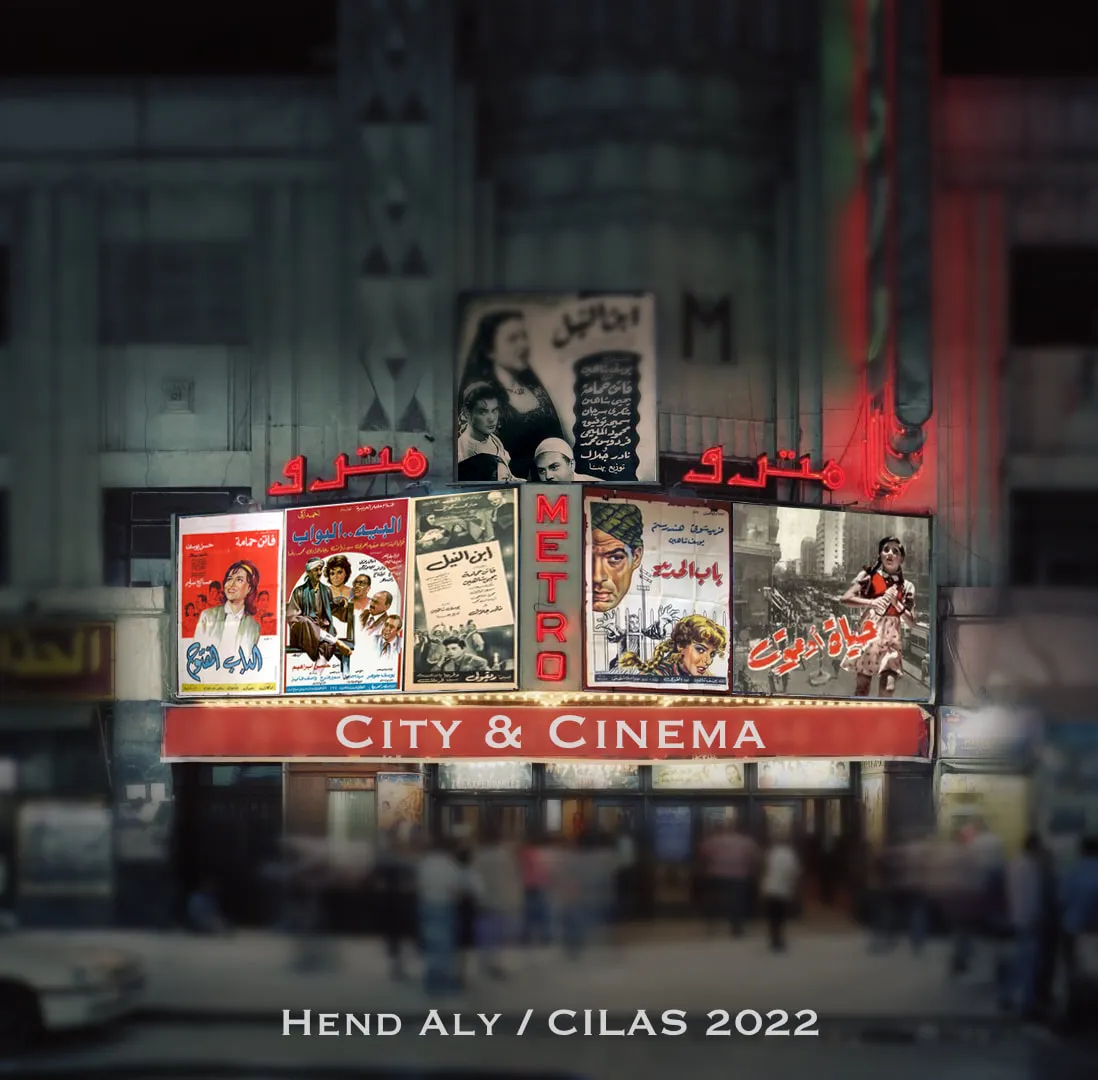
City and the cinema have always been interlinked. While the cinema represents an image of the city, its people and spaces, it simultaneously plays a major role in the production of its space. The relation between the city and the Egyptian cinema, dates to its early days. When Naguib el-Rehani in Salama fi Khair (1937) mocked the urban elite, Ismail Yassin in al-Attaba el-khadra (1959), days after arriving from the village bought one of Cairo’s most vital squares. Al Houb Fouk Hadba el-Haram (1986) and al-Souraa La Tazeed Aaan Sefr (1992) follow the suffering of Athar elHakim and Ahmed Zaki and Abla Kamel and Ahmed Bedier to find a house and practice their basic rights of marriage and housing. The city and urban life represented the childhood dream of Shukri Sarhan in Ibn el-Nile (1951) which turned into a disaster when it came true, while for Ahmed Zaki, and his family in elBeih el-Bawab (1987) moving to the city was a way to make a living which started with a harsh welcome but eventually provided him with the city’s endless opportunities. Bushra’s 678 (2010) daily commutes in the public bus reflected the suffering of Egyptian women facing harassment, while the public tram provided the child Doha Amir in Hayah aw Mout (1954) safe transport across Cairo to find the medication of her dying father, Emad Hamdy. This class dives deep into the city and its representation in the cinema. Employing a critical approach of contemporary urban political and economic landscapes, it familiarises the students with the main debates within academia and includes the movies as a lens to look at the broader questions on urban studies. Every week we will explore one of the urban spaces, starting from the railway station to public spaces, neighbourhoods, public transport, universities and waterfronts. We will focus every week on a different space, covering a broad range of issues which we encounter in our everyday life within these spaces. We will read and discuss housing, mobility, rural-urban migration, informality, segregation, inequality, citizenship, poverty, etc. After week one, which will function as an introductory class, each class will be composed of two parts. In the first part we discuss the readings and engage with academic debates, while in the second part a student/students will give a presentation on the space of the week, followed by a discussion.
Who teaches it
Hend Aly is an urban researcher and a consultant for the UN-Habitat. She has held various position in international organisations, governmental institution and civil society. She holds two post-graduate degrees in political science and urban studies. In her research, she is interested in bringing the political and the urban closer together to better understand the city. She has previously published on urban inequalities and citizenship, neo-liberal urbanism, authoritarianism, new cities, urban branding, urban governance and urban activism. Her research covers diverse cities including Cairo, Brussels, Vienna, Copenhagen, Madrid, Belgrade, Tirana, and new cities namely, NEOM. Her current research focuses on migration integration in an urban context.
Course flow
Sessions without a date
- What Is Critical Urban Theory?Core reading. Brenner, Neil. City 13, no. 2–3 (2009): 198–207.
- Cinema and the CityCore reading. Salmi, Hannu. In The Oxford Handbook of Cities in World History, edited by Peter Clarke, 1790–1825. Oxford, UK: Oxford University Press, 2013.
- Cinema, Cities and UrbanizationAdditional reading. Millington, Gareth. In Urbanization and the Migrant in British Cinema, by Gareth Millington, 19–44. London: Palgrave Macmillan UK, 2016.
- City and the FilmAdditional reading. Qasem, Mahmoud. Arab Press Agency, 2018.
- Urban Ideals and the Design of Railroad StationsCore reading. Chappell, Sally A. Kitt. Technology and Culture 30, no. 2 (1989): 354-375.
- Between Permeability and Isolation: A Comparative Urban Life Study of Inner- City Railway Stations and Their Node Precincts in ChinaAdditional reading. He, Shan. Athens Journal of Architecture 2, no. 2 (2016): 107–30.
- Railroad Space and Railroad TimeAdditional reading. Schivelbusch, Wolfgang. New German Critique, no. 14 (1978): 31-40.
- Tokyo Station City: The Railway Station as Urban PlaceAdditional reading. Zacharias, John, Tianxin Zhang, and Naoto Nakajima. Urban Design International 16, no. 4 (2011): 242–51.
- Cities for People, Not for ProfitCore reading. Brenner, Neil, Peter Marcuse, and Margit Mayer. City 13, no. 2–3 (2009): 176–84.
- The Urban Roots of Financial Crises: Reclaiming the City for Anti-Capitalist StruggleAdditional reading. Harvey, David. Socialist Register 48 (2012): 1–35.
- Egypt’s Housing Crisis: The Shaping of Urban SpaceAdditional reading. Shawkat, Yahia. Cairo New York: The American University in Cairo Press, 2020.
- Creating Inequality in Accessibility: The Relationships between Public Transport and Social Housing Policy in Deprived Areas of Santiago de ChileCore reading. Martínez, Cristhian Figueroa, Frances Hodgson, Caroline Mullen, and Paul Timms. Journal of Transport Geography 67 (February 2018): 102–9.
- Social Exclusion: What Can Public Transport Offer?Core reading. Stanley, Janet, and Karen Lucas. Research in Transportation Economics 22, no. 1 (2008): 36–40.
- Transport Accessibility and Social Exclusion: A Better Way to Evaluate Public Transport InvestmentAdditional reading. Suescún, Juan Pablo Bocarejo, and Daniel Ricardo Oviedo Hernández. 25. Lisbon, 2010.
- The Wall, An Increasing Phenomenon in Cairo: Main Reasons and Potential ImplicationsCore reading. Elnaggar, Yosra G., Yasser M. Moustafa, and Ayman F. Wanas. In Architecture and Urbanism: A Smart Outlook, edited by Shaimaa Kamel, Hanan Sabry, et. al, 269–87. Cham: Springer International Publishing, 2020.
- What Is Inclusive and Accessible Public Space?Core reading. Pineda, Victor Santiago. The Journal of Public Space 7, no. 2 (2022): 5–8.
- Commodification of the Egyptian New Capital: A Semio-Foucauldian Landscape AnalysisAdditional reading. Fawzy, Rania Magdi. Space and Culture, 9 February 2021.
- The Myth of a Safe Public SpaceAdditional reading. Hemeid, Bedour. 9. TU Delft, 2018.
- Leisure, Public Space and Quality of Life in the Urban EnvironmentAdditional reading. Lloyd, Kathleen, and Christopher Auld. Urban Policy and Research 21, no. 4 (December 2003): 339–56.
- Unequal Citizens: Between the Gated and the Informal in CairoCore reading. Aly, Hend. In Urban Inequalities, edited by Italo Pardo and Giuliana B. Prato, 73–91. Palgrave Studies in Urban Anthropology. Cham: Palgrave Macmillan, 2021.
- The Informal Social Pact: The State and the Urban Poor in CairoCore reading. Harders, Cilja. In Politics from Above, Politics from Below: The Middle East in the Age of Economic Reform, edited by Eberhard Kienle, 191-213. London: Saqi.
- The Prospects of Gentrification in Downtown Cairo: Artists, Private Investment and the Neglectful StateAdditional reading. Elshahed, Mohamed. In Global Gentrifications, edited by Loretta Lees, Hyun Bang Shin, and Ernesto López-Morales, 121–42. Bristol University Press, 2015.
- Re-Presenting The Egyptian Informal Urbanism In Films Between 1994 And 2014Additional reading. Mofeed, R., and N. Elgendy. International Scholarly and Scientific Research & Innovation 10, no. 6 (2 May 2016): 2044–50.
- The Changing Consumer Cultures of Modern Egypt: Cairo’s Urban ReshapingCore reading. Abaza, Mona. Theory, Culture & Society, 18, no 5 (2006): 97–122.
- Domesticating the Street: The Contested Spaces of the High Street and the MallCore reading. Jackson, Peter. In Images of the Street: Planning, Identity, and Control in Public Space, edited by Nicholas Fyfe, 173–88. London; New York: Routledge, 1998.
- Counterpublics in Saudi Shopping Centres, Beach Resorts, and Gated CommunitiesAdditional reading. Maneval, Stefan. Middle East-Topics & Arguments 12, no. 1 (2019): 76-86.
- Urban Markets as a “Corrective” to Advanced Urbanism: The Social Space of Wet Markets in Contemporary SingaporeAdditional reading. Mele, Christopher, Megan Ng, and May Bo Chim. Urban Studies 52, no. 1 (2015): 103–20.
- From the Urban University to Universities in Urban SocietyCore reading. Addie, Jean-Paul D. Regional Studies 51, no. 7 (3 July 2017): 1089–99.
- Universities’ Urban Impact in the Neo-Liberal ContextAdditional reading. Razavivand Fard, Haniyeh. In Neo-Liberalism and the Architecture of the Post Professional Era, edited by Hossein Sadri, 299–317. The Urban Book Series. Cham: Springer International Publishing, 2018.
- Gated University Campus and Its Implications for Socio-Spatial Inequality: Evidence from Students’ Accessibility to Local Public TransportAdditional reading. Sun, Cheng, Jianquan Cheng, Aiwen Lin, and Mingjun Peng. Habitat International 80 (2018): 11–27.
Get the CILAS newsletter
New courses, open calls and articles from CILAS, in your inbox.



18 October 2026
Join CILAS's Spring semester of 2026
- Spring 2026, Cairo